Skip to content

FREE ATHLETE GUIDE + FREE KŌRERO

LOTS OF ATHLETES HAVE A ROUTINE. LET’S MAKE YOURS WORK FOR YOU.

A free, research-informed guide to building a pre-performance routine that steadies you when it matters, without needing the nerves to disappear first. And if you’d like to explore how psychology might be shaping your performance more broadly, you can book a free 10 to 15 minute kōrero with our team.

No cost and no commitment. We’ll get back to you within two working days.

Free guide 11 pages · PDF · 144 KB · no sign-up

WHAT WE NOTICE

ROUTINES CAN DRIFT OVER TIME.

Athletes talk about pre-performance routines a lot, and that’s a great start. What we sometimes notice is a routine that has slowly become something else.

  • A LUCKY RITUAL

    Kept because it went well once, rather than because it helps you focus.

  • A LONG CHECKLIST

    So many steps that it becomes one more thing to get right.

  • A WAY TO FEEL CALM

    Measured by whether the nerves went away.

  • GAME DAY ONLY

    Saved for big moments, but rarely practised at training.

THE EVIDENCE

DOES IT HELP? THE RESEARCH SAYS YES.

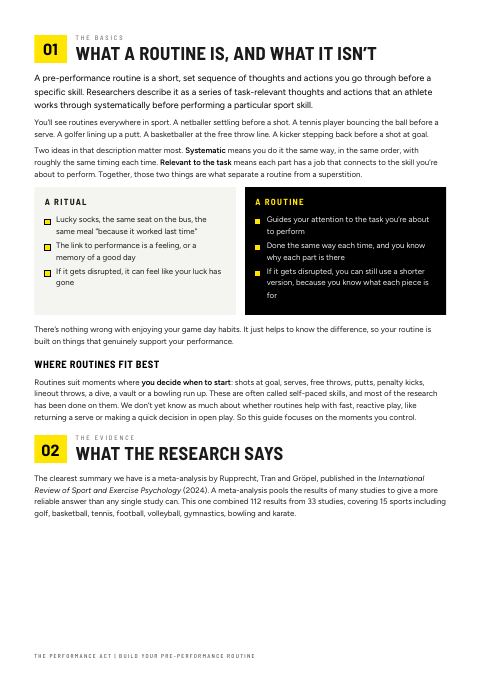
A meta-analysis brought together 112 results from 33 studies. Athletes who used a routine performed better than those who didn’t, and the difference was moderate to large.

  • 33 STUDIES pooled in one meta-analysis
  • 15 SPORTS golf, basketball, tennis, football and more
  • AGES 11 TO 40 beginners through to elite
  • ONE PIECE simple routines worked as well as longer ones

Worth knowing: the pressure findings are less precise, with fewer studies and only five in real competition.

Rupprecht, Tran & Gröpel (2024), International Review of Sport and Exercise Psychology, https://doi.org/10.1080/1750984X.2021.1944271 (opens in a new tab)

THE KEY IDEA

A ROUTINE IS AN ANCHOR, NOT AN OFF SWITCH.

Before an important moment, most athletes notice some mental noise: thoughts like “don’t miss this”, nerves, a racing heart, the crowd. If your routine’s job is to make that noise disappear, every nervous moment feels like the routine has failed, and the noise stays centre stage. If its job is to give your attention somewhere to come back to, the noise can stay and you can still commit to the skill. Over time, many athletes notice the noise has less grip.

IF YOUR ROUTINE IS AN OFF SWITCH The noise becomes the problem to solve Noise shows upthoughts, nerves, body Use the routine tomake it go away Check: has thenoise gone? Still there, so theroutine has “failed” More checking, more worry, more noise IF YOUR ROUTINE IS AN ANCHOR The noise can stay. Your attention has somewhere to go. Noise shows upthoughts, nerves, body Notice it andlet it be there Come back to yourroutine and focus Commit tothe skill Over time, the noise often has less grip
The same noise, two different loops.

AN ANCHOR DOESN’T STOP THE WAVES. IT STOPS YOU DRIFTING.

THE PROCESS

BUILD YOURS IN FIVE STEPS.

  1. CHOOSE YOUR MOMENT

    One skill where you decide when to start: a shot at goal, a serve, a free throw, a putt.

  2. FIND YOUR FOCUS

    The one thing your attention needs to land on, in one or two words.

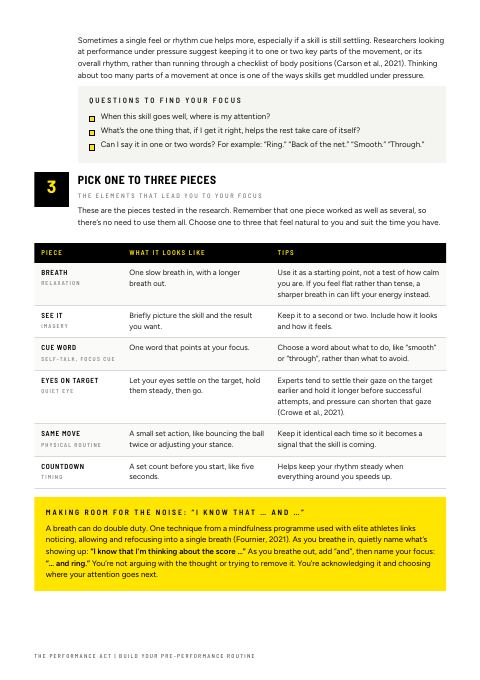
  3. PICK ONE TO THREE PIECES

    A breath, a picture of the result, a cue word, eyes on the target, a set move or a countdown.

  4. PUT IT IN ORDER AND TIME IT

    Same sequence and rhythm each time, plus a short version for when you’re rushed.

  5. PRACTISE IT WITH THE NOISE

    Calmly at first, then with a little pressure, so it’s familiar before you need it.

THE NOISE YOURROUTINE SHORTVERSION “Don’t miss this” racing heart the crowd the last mistake “What if …” Drifted to the noise? Notice it, let it be there, come back to the next piece. SETTLE breath or same move SEE IT picture the result POINT ATTENTION cue word, eyes on target GO commit to your focus SAME ORDER, SAME RHYTHM, EVERY ATTEMPT ONE PIECE e.g. one breath for when you’re rushed or interrupted GO same focus
The shape of a routine, with the noise still there.

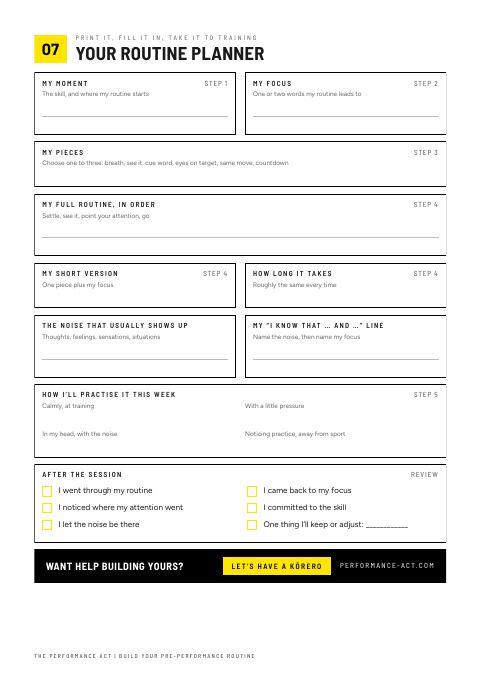
The full guide walks through each step, with examples from six sports, troubleshooting tips and a printable routine planner.

From The Performance Act, a team of registered psychologists working in sport.

IN THIS GUIDE

  1. What a routine is, and what it isn’t
  2. What the research says
  3. A routine is an anchor, not an off switch
  4. Build yours in five steps
  5. Examples from different sports
  6. When things go off script
  7. Your routine planner

A LOOK INSIDE

Free to download. No email or sign-up needed.

LET’S HAVE A KŌRERO

WANT TO EXPLORE THE MENTAL SIDE OF YOUR PERFORMANCE?

A routine is one piece of the picture. If you’re curious how psychology might be shaping your performance, book in for a free 10 to 15 minute kōrero about what’s going on for you. It’s a genuine chat with someone who understands sport from the inside, with no pressure and no obligation, and we’ll go from there.

YOUNG ATHLETES AND WHĀNAU

Many of the athletes we work with are rangatahi, and a parent or caregiver often gets in touch first. That’s great. The kōrero is a chance for you both to ask questions, and for us to understand your sport, your goals and what’s getting in the way.

Book a kōrero for your young athlete

ADULT ATHLETES

Whether you’re competing, coming back from injury, juggling sport with work and life, or chasing a new goal, the kōrero is a relaxed way to talk about where you’re at and whether working together makes sense.

Book your free kōrero

WHO YOU’LL TALK TO

  • JAMES ORRITT

    Registered Clinical Psychologist, NZ Psychologists Board

    Co-Founder

    BSpC, BSc, PGDipClinPsyc, MSc

Meet the team

WHAT HAPPENS NEXT

A SIMPLE, THREE-STEP START.

  1. 01

    Fill in the form

    A short enquiry form. Parents and caregivers can fill it in for their young athlete.

  2. 02

    A free conversation

    A 10 to 15 minute chat to understand where you’re at.

  3. 03

    A clear next step

    We’ll talk about what support could look like, whether that’s working together, the free guide, or something else that fits you better.

We’ll get back to you within two working days.

QUESTIONS

Is the kōrero really free?

Yes. It’s a free 10 to 15 minute conversation, with no commitment and no obligation.

Does the kōrero have to be about my routine?

No. It’s a chance to talk about whatever’s going on for you in your sport, whether that’s nerves, confidence, motivation, coming back from injury or something else. We’ll listen, and we can go from there.

Do I need to be an elite athlete?

No. We work with athletes at every level, and the research on routines found benefits from beginners right through to elite.

Can my parent or caregiver be involved?

Yes. For younger athletes, it’s common for a parent or caregiver to get in touch and be part of the conversation.

Who will I be talking to?

James Orritt, a registered clinical psychologist working in sport and one of the co-founders of The Performance Act.

Is this therapy?

Our work focuses on the mental side of sport and performance. If something bigger is going on, we’ll talk honestly about what kind of support would fit best.

Where are you based?

We’re based in Ōtautahi Christchurch and work with athletes across the motu, in person and online.

Can I share the guide?

Yes, please do. Send it to teammates, your coach or whānau. It’s free, and there’s no sign-up.

Do I have to read the guide first?

Not at all. You can book a kōrero, download the guide, or both.

WANT TO TALK IT THROUGH? LET’S HAVE A KŌRERO.

We’re not a crisis service. If you need help right now, see the support options below.

Need immediate support?

The Performance Act is not a crisis service. If you or someone you care about needs to talk to someone right now, 24/7 helplines are one tap away.

Book a free kōrero